Inside RealmForge: how we build Mithrall's worlds
Our internal world-generation tool builds 256 km² multi-biome maps in under two minutes. Here is what it does, why we built it, how Mithrall actually uses it, and what a partially procedural world means for players when seasons reset the board.
A note before we get into it.
Mithrall is still cooking. The build out in the world is over a year behind where we are internally, and we are going to keep widening that gap until we ship the next playable version. This is the first technical devlog in what is going to be a regular thing. We will talk through the systems we are building, the decisions behind them, and what they mean for the players who are going to live inside them.
Today, RealmForge. The tool that builds Mithrall's worlds.
What it does
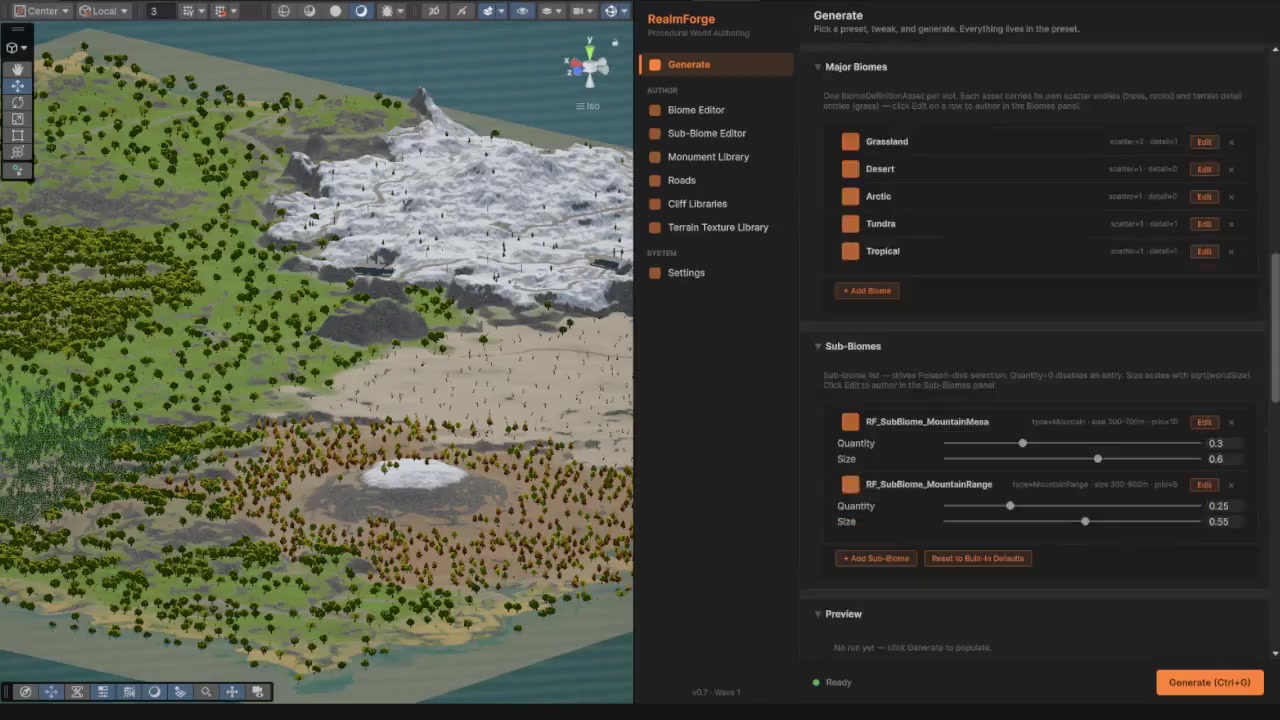
RealmForge is our internal world-generation tool. Its goal is simple: generate any kind of map, with both procedural and handcrafted parts, seamlessly blended. POIs, biome transitions, road networks, monuments and major structures, all stitched together in a single pass.
The clip below is a showcase reel. You will see several different biome configurations running back to back, sometimes multiple biomes at once on the same map. That is RealmForge stretching its legs, showing what it is capable of, not what a single Mithrall region is going to look like.
The clincher is at the end: a full multi-biome map of 256 km², generated in under two minutes. For context, world-generation systems with this kind of fidelity have historically been minutes-to-hours of compute even at the best studios. Rust's procedural map system is the comparison most people reach for. We built something on that level of sophistication, in two months, with a team that fits around a small table.
How Mithrall actually uses it
Reading the words "procedural map generation" people sometimes picture one big procedural blob. That is not what Mithrall is going to be.
One realm in Mithrall is a full set of interconnected servers grouped into regions, similar in shape to how Albion Online structures its world. Each region has its own map, its own theme, its own role in the realm:
- Some regions are PvE-leaning, with deep dungeons and world bosses
- Some are PvP hotspots, contested zones around high-value POIs
- Some host cities, safe trade hubs, faction strongholds
- Some are pure wilderness for solo exploration and resource gathering
Each region map sits somewhere between 10 and 50 km² at the upper end. RealmForge generates each one with its own biome mix, its own POI layout, its own road network. The showcase clips you just watched stitch multiple biomes together for visual punch. The reality is more like one carefully composed map per region, dozens of regions per realm, ninety-plus across the full live setup.
That smaller per-region footprint also matters for loading times. Crossing from one region to another is a server-to-server transition with a load screen, and the smaller maps keep those transitions short. We will iterate on that as we go, but the structural decision was made early with that constraint in mind.
What it means for you
Three things, mostly.
1. Wipes feel like a new game
In a partially procedural world, end-of-season or wipe events stop being "same map, fresh inventories." They become a full re-shuffle of the cards. The regions look different. The POIs are in different places. The biome arrangement changes. There is real new world to discover every time.
2. The map keeps evolving
RealmForge will keep improving alongside the game. Every season, every wipe, we expect to introduce new dungeons, new POIs, new types of challenges, new biomes. The tool grows with Mithrall, and the variety you see in the game grows with it.
3. Power can shift
We know a chunk of the community is skeptical about procedural wipes. Let's be honest about why we think they're necessary.
In long-running games with static worlds, you eventually end up with a handful of mastodon clans that control everything. They sit on the best POIs, the best resources, the best chokepoints. New players and smaller groups try to compete and quickly figure out the deck is stacked. A lot of them stop playing. We have all watched it happen.
A reshuffled map is one of the strongest counterweights to that dynamic. It does not reset the skill gap (skill should still win), but it resets the positional monopoly. People who felt powerless get a fair shot at thriving again. The old kings have to fight to keep their crowns. That is the kind of game we want to keep alive for years, not the kind that calcifies after season two.
Why we built it
The honest answer: we had to.
Every previous AnkleBreaker title was hand-crafted by our level designer, someone we love working with, who is genuinely excellent at the craft. But Mithrall is a different scale. Ninety-plus server regions by hand was not a tedious option. It was not an option at all. Not for a team our size, not without millions of dollars in level-design headcount we do not have.
There is also a less obvious thing worth saying out loud: a tool like RealmForge would have cost hundreds of thousands of dollars, possibly millions, to develop a few years ago. Not because the expertise was rare. Because tools at this depth historically take years to write.
We built RealmForge in two months.
That is not a flex. That is what happens when you use AI seriously inside the studio. We talked about this in our stance about AI, so go read that one if you have not. Short version: AI does not replace the engineers and designers and artists who make the studio what it is. It makes us roughly ten times more effective at the parts of the work that used to eat months of calendar time. Tools, generation, content pipelines, internal systems. RealmForge is one of the clearest examples of what that compounding actually looks like.
Where this fits in the bigger picture
This is the first technical devlog. There are going to be more. We want to give you a real window into the work, the decisions, the trade-offs. The stuff that does not usually leave the studio.
The other piece coming up: low-scale playtests and internal tests. We would love to involve people from the community who want to actually shape the game by sharing their thoughts on those builds. More on that as we get closer.
In the meantime, thanks for the patience. We are cooking hard. We could have shipped Mithrall a year ago and it would have been mid. We are not interested in shipping mid. We will keep showing you the work as it comes together, and when the next playable build is ready, it will be ready.
See you around.
- François