The Machine Behind Mithrall
The playtest platform is live, and it is only the visible tip. TombStack, Nodary, Engraver, our FishNet work at MMO scale, a new art pipeline: a full behind-the-scenes tour of the machine we are building around Mithrall while we rebuild it.
This is the longest devlog we have written. Grab a coffee.
If you follow us, you have noticed a pattern lately. We keep saying things are coming. The internal build is pulling ahead. The quality bar is rising. A lot of teasing, not a lot of showing. We know that can be frustrating, and we would rather explain it than let you guess. The rebuild we are in takes time. The alternative was a year of silence, and we already made that mistake once. Never again.
So today we are opening the workshop door. Not on one system, on all of it. The playtest platform. The crash tooling. The document platform the whole studio runs on. The save system. The netcode work. The art pipeline. The machine we have been building around Mithrall while we rebuild Mithrall itself.
One thing before we start: this post is not the graphics reveal. There is a single image near the end that shows where the art direction is going, clearly labeled as concept. The proper look at the new visual quality deserves its own moment, and that moment is coming.
One account. Every game.
Let's start with the thing you can actually click.
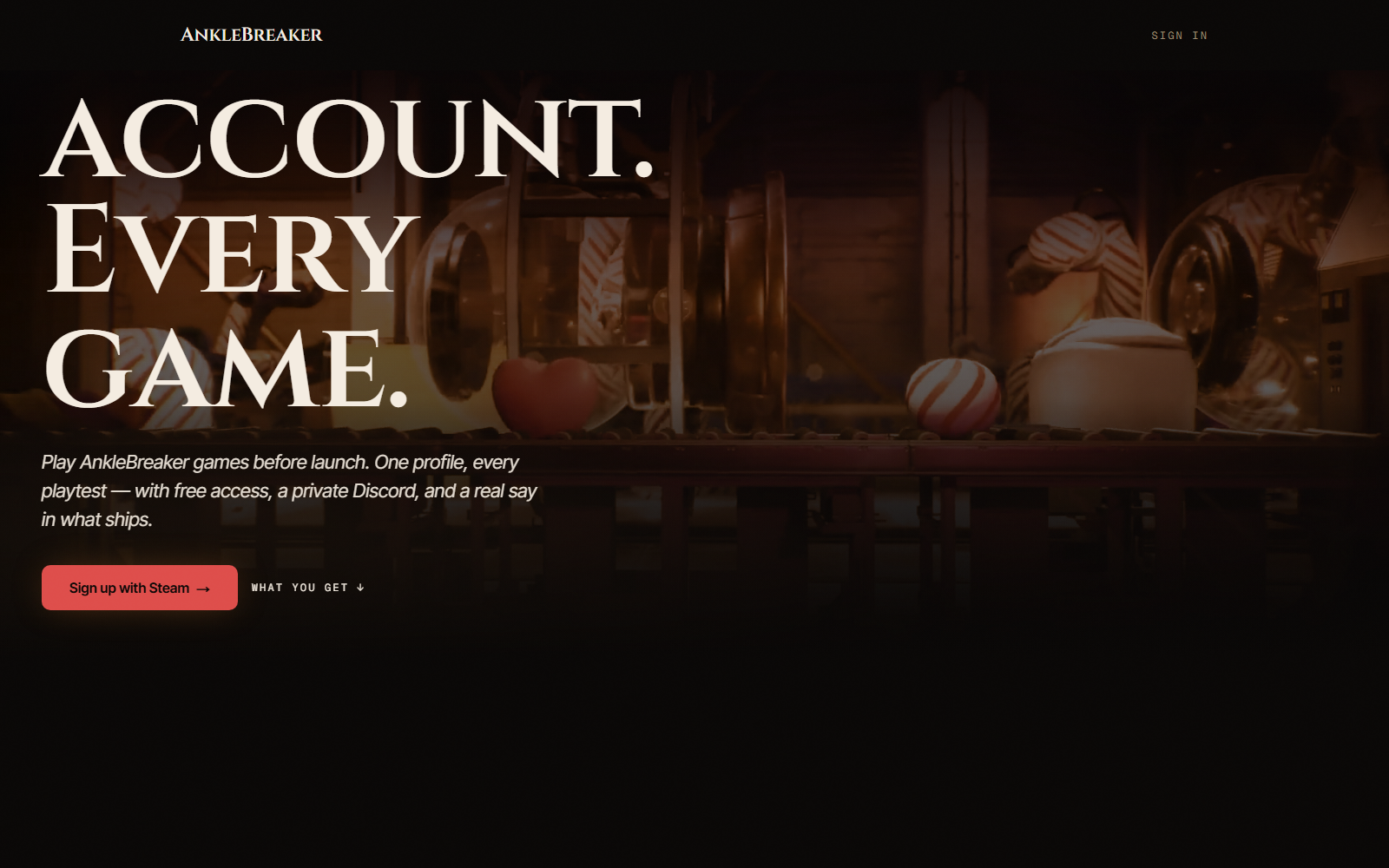
The AnkleBreaker Playtest platform is live at playtest.anklebreaker-studio.com. It is not fully finished. Some corners are still visibly under construction, and we are fine with you seeing that. What works today: you can create your account, verify with Steam, email and Discord, and fill out your tester profile once. That profile carries across every playtest we will ever run, for every game we ship.
Here is the deal it exists to make. You apply to a playtest plan. Each plan has a brief, a deadline and a limited number of slots. If you are accepted, you get a Steam key or a Steam Playtest grant, an invite to that game's private playtest Discord, and one NDA that covers you across the program. You play, you tell us what is broken, and the feedback goes straight to the people building the game. No purchase, no catch, and a Playtester badge in-game for your trouble.
There are two ways in. The open Playtest track is for anyone: scheduled windows, a short survey, done. The Insider Program is the other track, and it is earned, not bought. Insiders sit closer to the metal: pre-alpha builds, a direct line to leads, and real duties, written reports and weekly playtime. You get invited by showing up consistently in the open playtests first. We announced the Insider idea back in May. This platform is where it becomes real.
The behind-the-scenes part: the public site is the visible tip of the backend that now runs our games operations. Playtest cohorts, key distribution, server fleet monitoring, moderation and ban appeals, analytics, all one pipeline. That backbone has taken more than 800 commits since May alone. When the first Mithrall playtest wave opens through it, the invite email, the key in your library and the Discord role all come out of the same machine. Sign up now and you are in the pool the day that happens.
Why a ten-person studio keeps building tools
Before the next four sections, the honest question: why does a small studio keep producing internal tech instead of just making the game?
Because we tried making games without it, and we shipped the scars. We wrote about this in our stance on AI: we are ten people doing the work of sixty, and the multiplier comes from tooling. RealmForge proved the pattern in May: a world-generation tool that would have taken years, built in two months, now generating 256 km² maps in under two minutes. Every tool below exists for the same reason. We hit a wall shipping real games, and we decided the wall should stop existing, permanently, for every project after this one.
Two of these tools grew past internal use and became products. That was not the plan. It is what happens when something you built for yourself gets good enough that keeping it private starts to feel silly.
TombStack: every crash tells a story
Most studios never hear the story. A player's game dies on hardware you have never seen, they shrug, maybe they refund, maybe they leave the review that says "crashes constantly" and never come back. The crash itself vanishes.
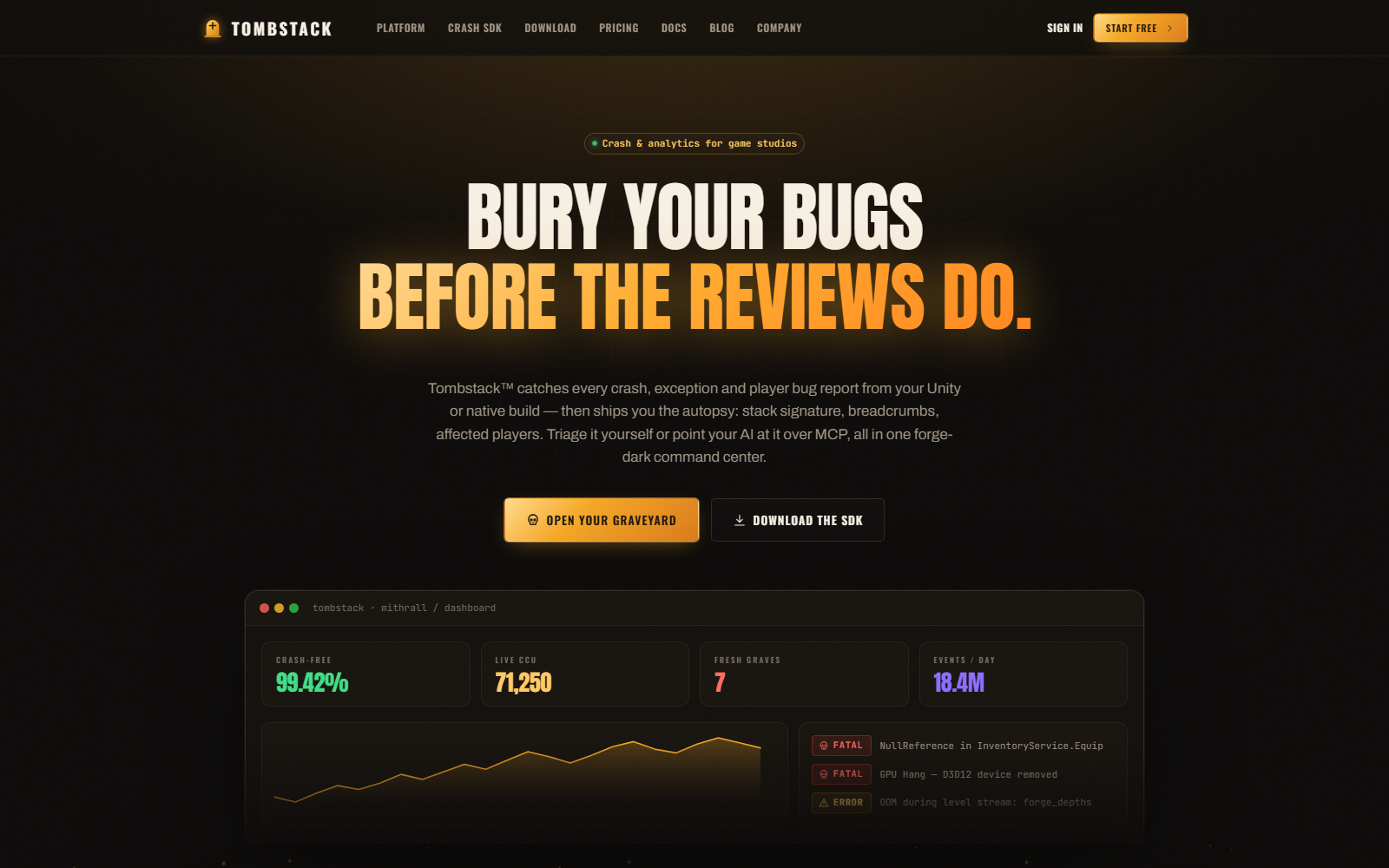
TombStack is our answer. It catches every crash, exception and player bug report from a Unity or native build, then ships you the autopsy: the stack signature, the breadcrumbs leading up to it, how many players are affected, whether it is brand new or a regression of something you already fixed. Sessions and concurrency come along for the ride, so you also know what "3 percent of players" actually means. And because we are that kind of studio, it has an MCP server, so an AI agent can triage your crash queue while you sleep.
The name is a nod to the "tombstone" files Android writes when a native process dies. Getting from a tombstone to a readable stack trace on an IL2CPP build is genuinely miserable, so we made symbolication a first-class citizen: our build pipeline uploads the full Unity symbols archive and the platform works out every module and ABI by itself.
This is not a concept. TombStack watches Kickdom, the mobile title we built and shipped, directly from its CI today. Real builds, real symbols, gigabytes of them, every native crash symbolicated. There are more than 1,150 unit tests behind the platform, the Unity and native SDKs are already public on our GitHub, and everything is hosted in the EU, in Paris. It is in private beta while we harden it on our own games. It will open. If crash triage is your daily pain, keep an eye on it.
Nodary: where the design docs live
An MMO does not have a design doc. It has hundreds, and they are all secretly connected. Combat touches the economy. The economy touches territory. Territory touches server architecture. Keep that web in folders and pages and it rots quietly: two documents contradict each other for months and nobody notices until the feature is half built. We call it the doc graveyard, and we lived in one.
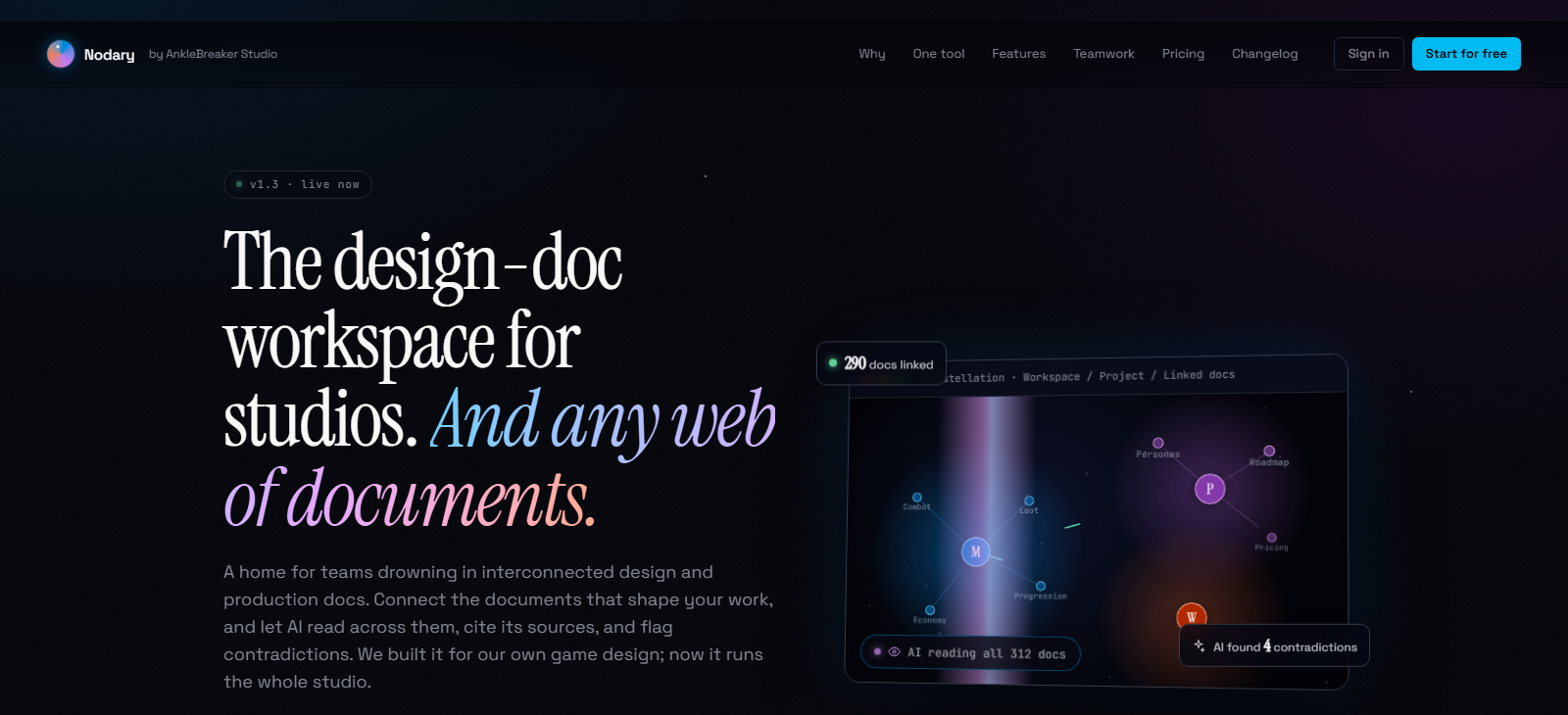
Nodary is what we built instead. Every document is a star. Links between documents are real edges you can see and navigate, so the workspace looks like a constellation of your project instead of a filing cabinet. And the part that changed how we work: the AI reads across the linked documents, answers with citations, and flags contradictions and gaps between them. "Which mechanics depend on the economy system" stopped being an afternoon of archaeology and became a question you just ask.
It was born from Mithrall's own design documents, and at this point it runs the whole studio: the design canon, decision ledgers, onboarding, all of it lives there. It is live at nodary.ai, and real-time co-editing shipped for everyone this week. If your team is drowning in interconnected docs, game studio or not, it is open to try.
Engraver: saves that survive
Now the unglamorous one, and secretly one of the most important.
In a survival sandbox, the world is the save. Terrain modifications, thousands of building pieces, every door, every chest, clan rosters, auction listings. Persistence at that scale breaks naive save systems in two reliable ways: the crash mid-write that corrupts the file and eats a player's base, and the autosave stutter that freezes the frame every time the world writes to disk. Both are unacceptable. Both are usually accepted.
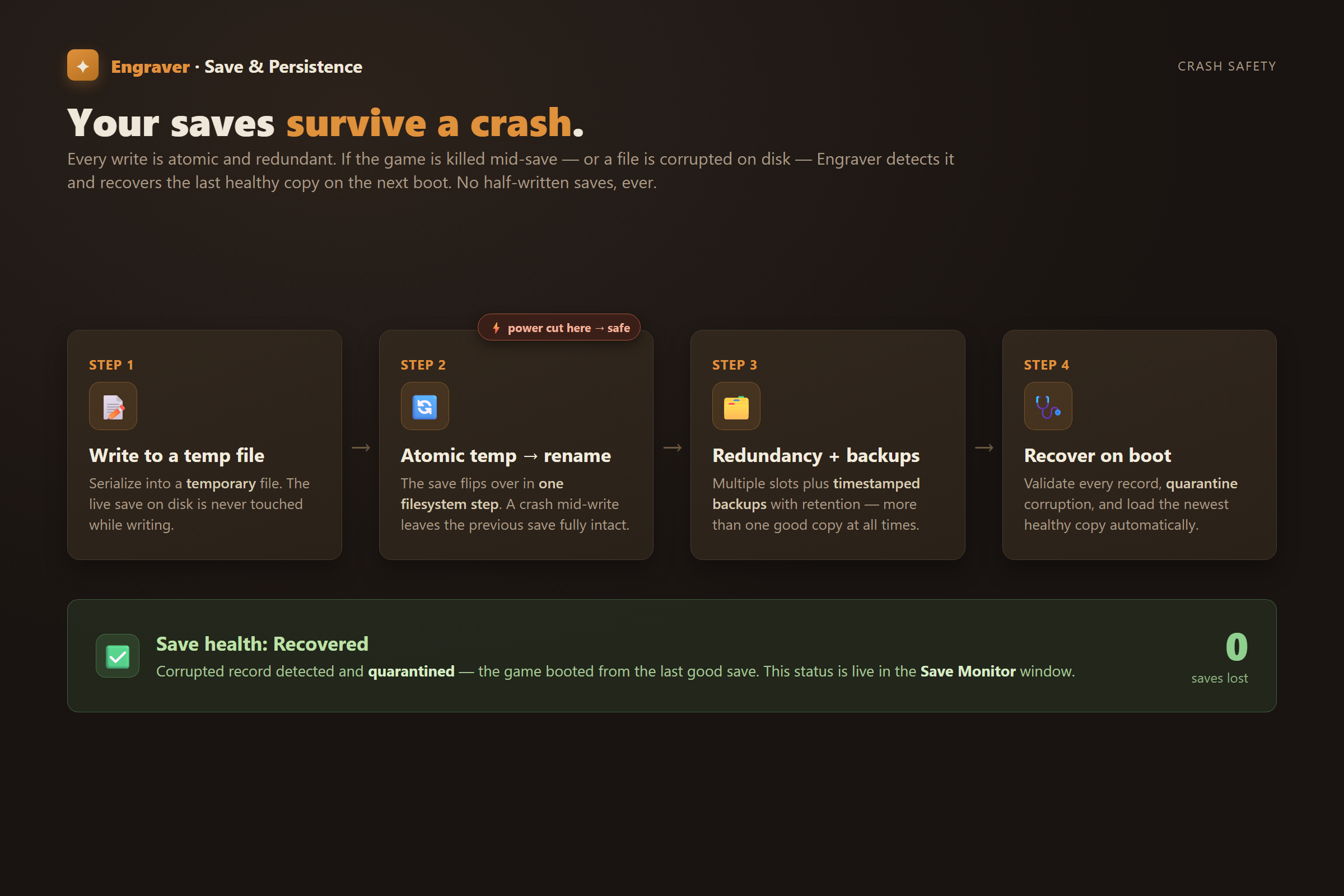
Engraver is our save and persistence system for Unity, and it refuses both. Every write is atomic: serialize to a temp file, then swap in a single filesystem step, so a power cut mid-save leaves the previous save fully intact. Multiple slots, timestamped backups with retention, corruption detection with quarantine, and automatic recovery of the last healthy copy on boot. Zero lost saves is not a slogan, it is the tested behavior.
The no-freeze part is the one we enjoy showing off:
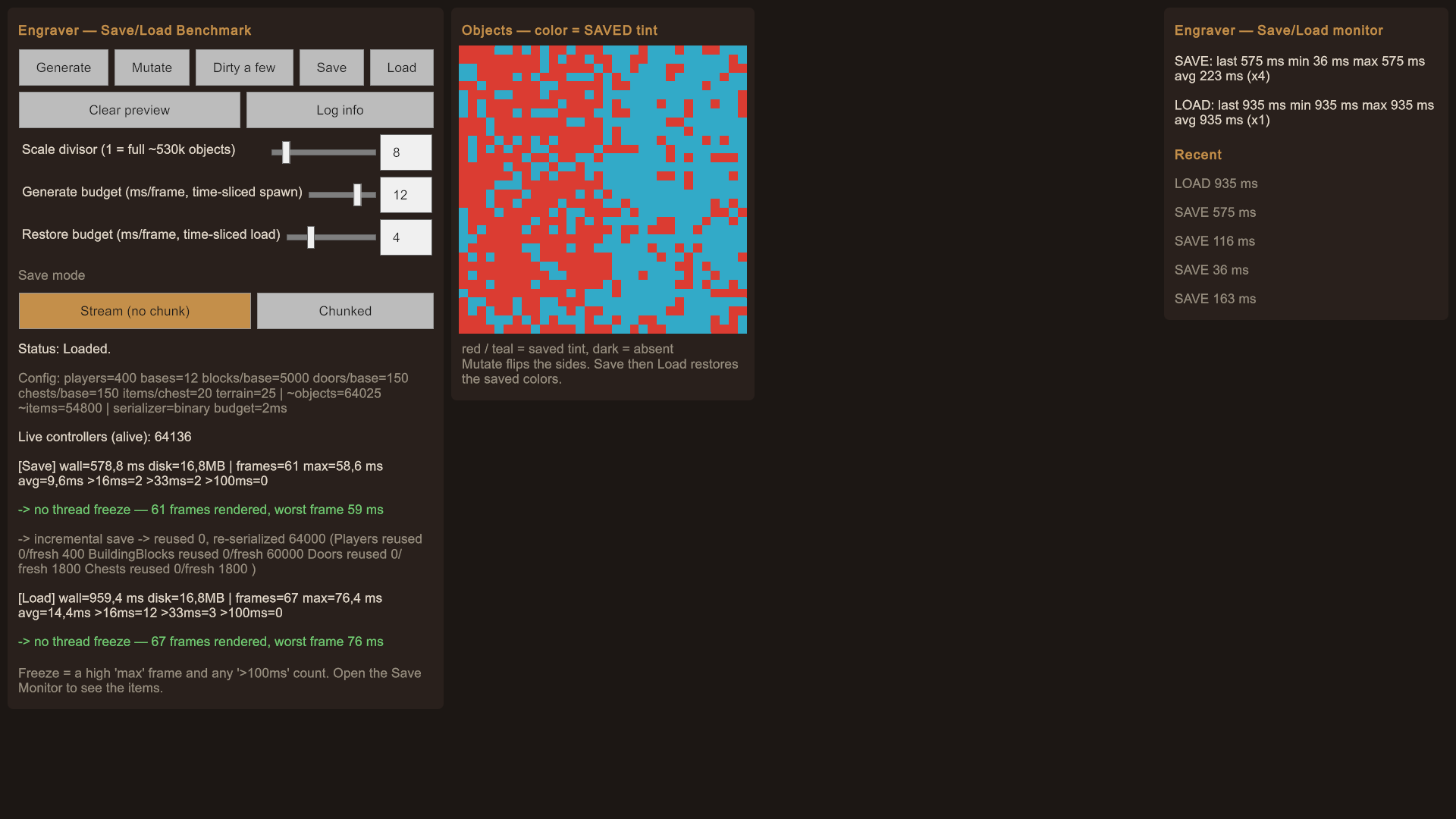
That benchmark scene holds around 64,000 live objects. Saving them takes 578.8 ms of wall time, spread across 61 frames. Worst frame: 58.6 ms. Frames over 100 ms: zero. The game keeps rendering while the world writes itself to disk, and our scale tests push the same architecture to roughly 530,000 objects. It also ships with a Save Monitor window that shows save health live in the editor, a FishNet module for server-authoritative persistence and reconnection, and an ECS module for our DOTS-heavy projects.
Here is the part that still surprises us: Engraver went from first commit to store-ready in about a month. That is what our current pace looks like when a wall needs to stop existing. It is headed to the Unity Asset Store, and the store captures you see here were finished this week.
The netcode: FishNet, pushed to MMO scale
Time to say something plainly that we have never said in public: Mithrall's multiplayer is built on FishNet, the Unity networking library by First Gear Games. We think it is the best netcode available on the engine, and our whole stack stands on it.
Stock FishNet is tuned for the games most people make with it: mid-scale action, a few dozen players. Mithrall lives in a different regime. Upwards of a thousand concurrent players on a single server process, with many of those servers meshed into one realm. Login storms when a playtest opens. Tens of thousands of networked objects that spend most of their life idle. Servers that stay up for weeks. In that regime, you find the bugs and bottlenecks nobody else was looking for.
So we maintain an internal, improved build of FishNet, and this is where a chunk of the last months went. A few of the results, each one measured on our test rig before it was allowed to ship:
- A garbage collection churn of 30 to 100 MB per second at 1,000 CCU: eliminated.
- The header of the most frequent packet type on the wire: 60 percent smaller.
- Unnecessary client physics replays in our deterministic prediction test: 1,080 every 4 seconds, down to 0.
- A dirty-object flush that scaled quadratically with object count: now linear.
On top of the fixes, the build adds the modules an MMO needs: killcam and replay capture, zone handoff for server meshing, instanced dungeons through scene stacking, live server metrics. Twenty-one internal builds shipped in the last nine days. House rule: every change lands with a measured number or a regression test, and ideas that failed go into a refuted-claims ledger so we never chase the same ghost twice.
To be clear about the boundaries: FishNet Pro is a licensed asset, our improved build stays strictly in-house, and nothing gets redistributed. When we find genuine upstream bugs we report them with full reproductions, like the 32-bit Android crash inside a prediction serializer that we root-caused to an IL2CPP code generation issue and worked around the same week. Standing on an open source project means contributing back the only thing that is ours to give: the bug reports from a regime almost nobody else tests.
One more teaser while we are here: we are building a multiplayer testing workbench that boots entire fleets of Unity clients against a server build automatically. QA at MMO scale cannot be twelve people pressing W. More on that another day.
The art bar is moving
When we wrote why Mithrall is going third person, we said everything was being rebuilt at a higher bar. That includes how the game looks, and this is where the teasing has been the loudest and the showing the thinnest. Let's fix a little of that.
There is a new environment art pipeline in the studio. Hand-sculpted modular cliff and rock kits. A full stylized vegetation set. Strict tiling texture standards so every material reads clean at every distance. City districts being blocked out in engine on top of printed floor plans, the old-fashioned way, because layout is gameplay before it is beauty.
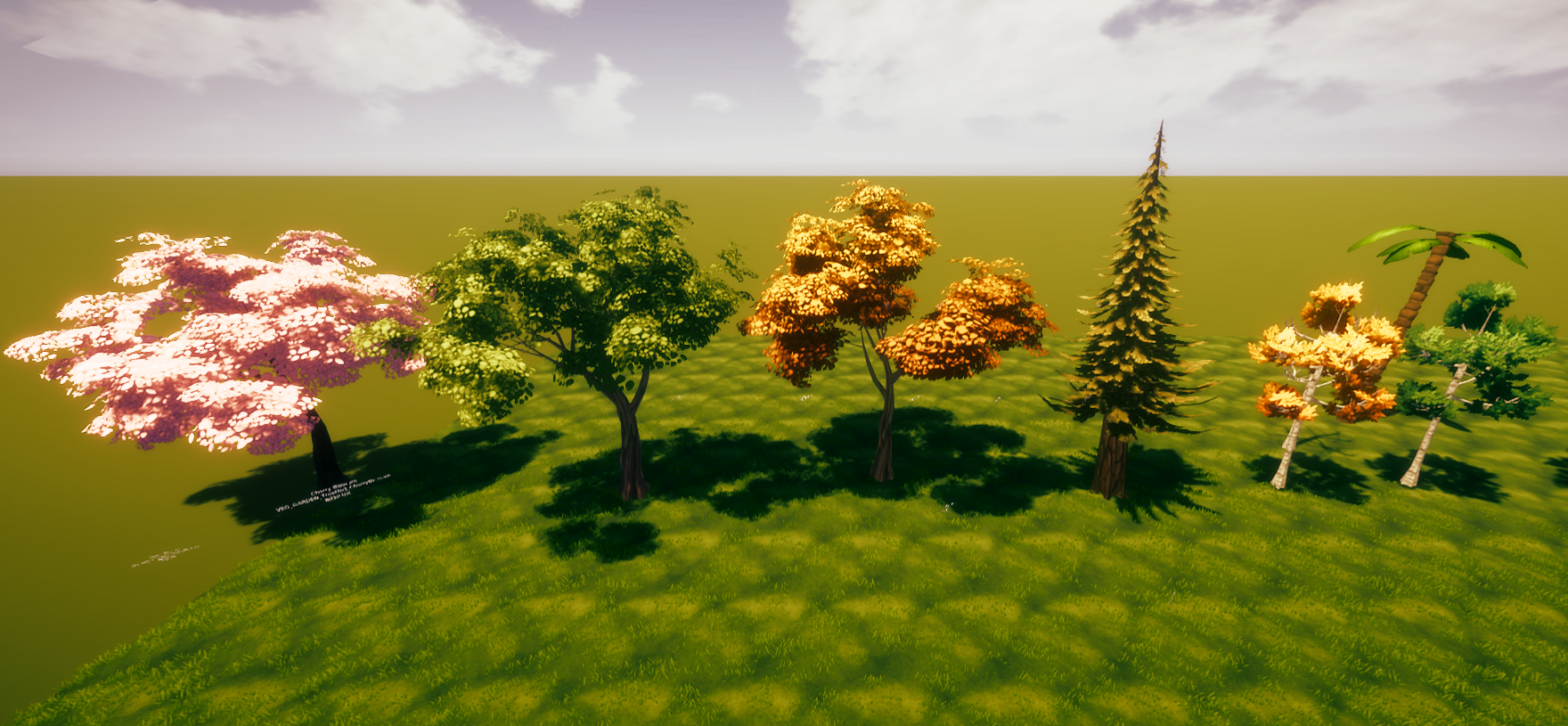
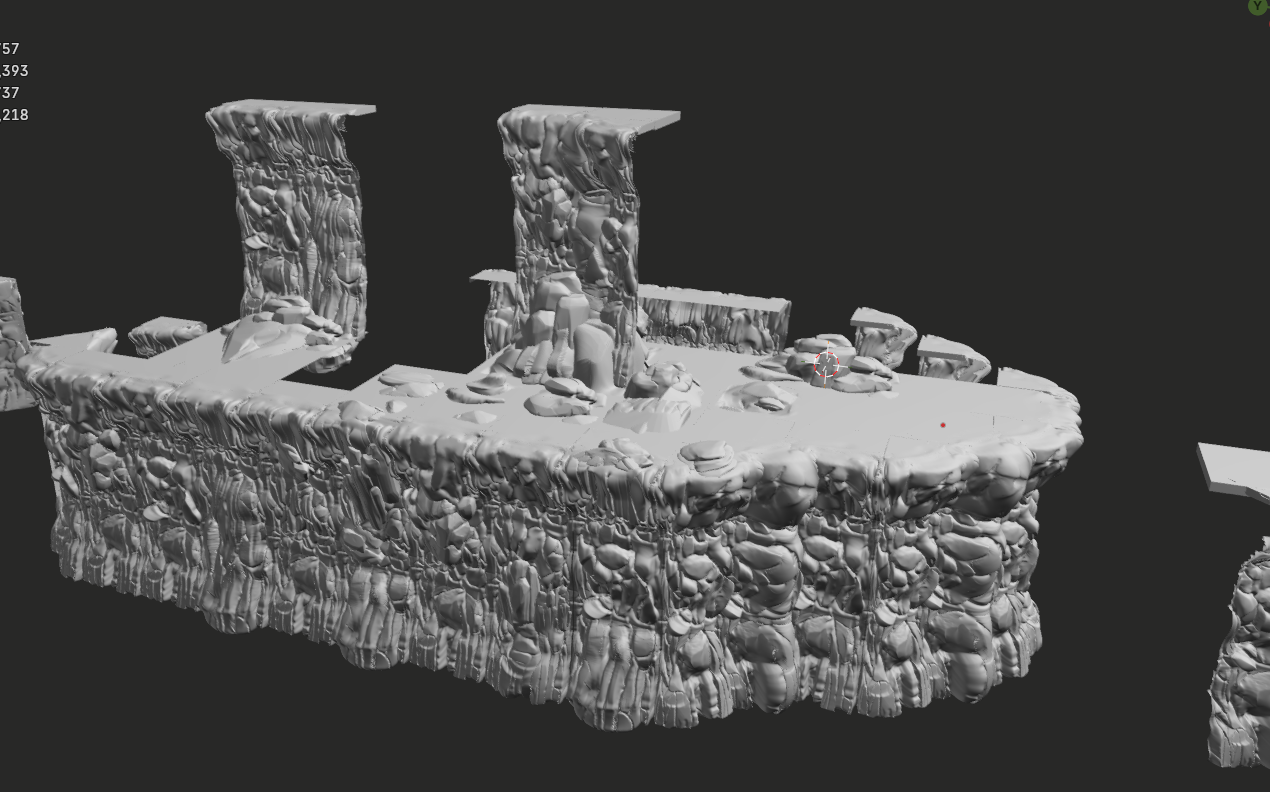
Both shots above are work in progress, straight from the pipeline: the vegetation kit running in engine, and the high-poly sculpt of a modular cliff kit before baking. Hand-made kits like these also feed RealmForge, so the generated worlds inherit the handcrafted quality instead of fighting it.
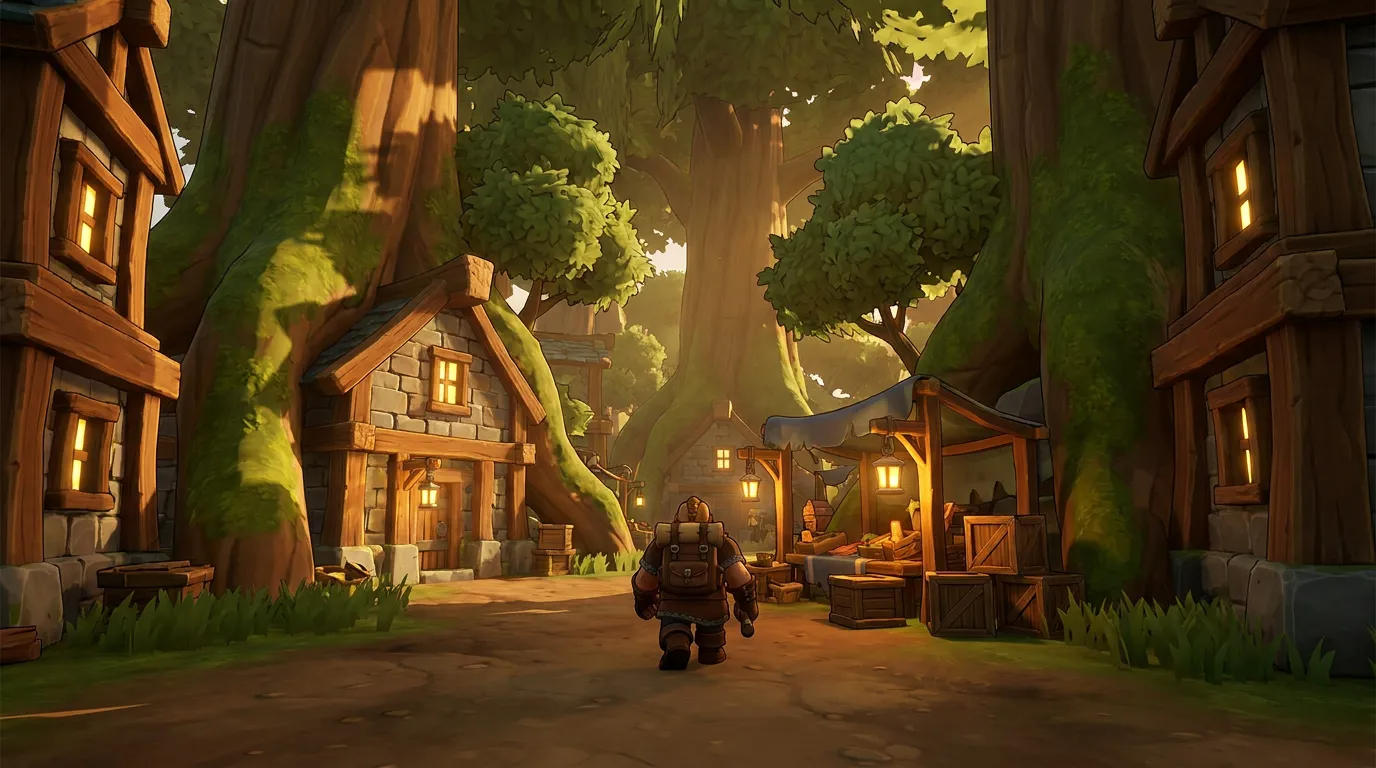
And this is the direction all of it is being built toward:
Full honesty, as always: that image is concept art, a visual target, not a screenshot. But it is not a dream either. It is the bar the kits above are being measured against, asset by asset. When we show you the new Mithrall, we want it moving, in engine, in front of you. That is the reveal we are working toward, and we can't wait.
What all of this means for Mithrall
Step back and the pieces stop looking like separate projects.
RealmForge builds the worlds. Engraver makes them persistent. FishNet, in our improved build, moves a thousand players through them. TombStack watches every build and tells us what broke before you have to. The playtest platform puts you inside, with one account and a real feedback loop. And Nodary keeps the design of all of it coherent while it grows. None of these is glamorous on its own. Together, they are the reason the quality of everything we make is rising every single day, and the reason we have never moved this fast: more than 800 commits on the platform since May, 450 on TombStack, 21 netcode builds in 9 days, a full save system in a month.
Mithrall's window is unchanged: Q4 2027, as announced with the trailer in June. We are not putting dates on the steps in between until they deserve one. What we can promise is what this post is: we will keep showing you the work, including the unglamorous parts, while it happens.
If you want to be part of it, three things. Create your tester profile at playtest.anklebreaker-studio.com, it takes two minutes and it puts you in the pool for the first wave. Wishlist Mithrall on Steam if you have not. And come argue with us in the Discord, the door is open.
Thanks for reading this far, and thanks for the patience. It is being repaid in work.
See you in the next one.
- François